The short version
Six things on a specialty coffee bag tell you almost everything: origin, producer, altitude, variety, process, and roast date. Learn to read those and you can predict — with surprising accuracy — how a coffee will taste before you've brewed a drop.
Most supermarket bags hide behind words like "rich," "smooth" and "100% Arabica." A specialty bag does the opposite: it's a spec sheet, printed with pride. Here's what each line is telling you.
1. The roaster and the coffee's name
The roaster is who turned green seeds into the beans in your hands — the craftsperson whose judgment you're trusting. The coffee's name is usually the farm, producer, washing station, or region it came from (e.g. "Finca El Paraíso" or "Guji"). A made-up romantic name with no place attached is a small red flag.
2. Origin — country, region, producer
Specialty coffee is traceable, so the label goes as deep as it can: country → region → farm or co-operative → sometimes the individual producer. The more specific it gets, the more the roaster knows about exactly what they bought. "Ethiopia" is fine; "Ethiopia · Yirgacheffe · Konga washing station" is better.
3. Altitude
You'll see something like 1,800–2,100 masl (metres above sea level). Altitude matters because cooler high-grown coffee matures slowly, producing denser beans with more concentrated sugars and brighter, more complex acidity. As a rough guide, most prized specialty coffee grows above ~1,500 m. (Central American grading shorthand like SHB — Strictly Hard Bean — or SHG — Strictly High Grown — means the same thing.)
4. Variety
The cultivar — Bourbon, Typica, Caturra, Catuai, SL28, Pacamara, Gesha, Pink Bourbon and others. Think of it like grape varieties in wine. Some hint loudly at flavour: Gesha at jasmine and bergamot, SL28 at blackcurrant, Bourbon at rounded sweetness. You don't need to memorise them — just know that a listed variety is a sign of a roaster who cares.
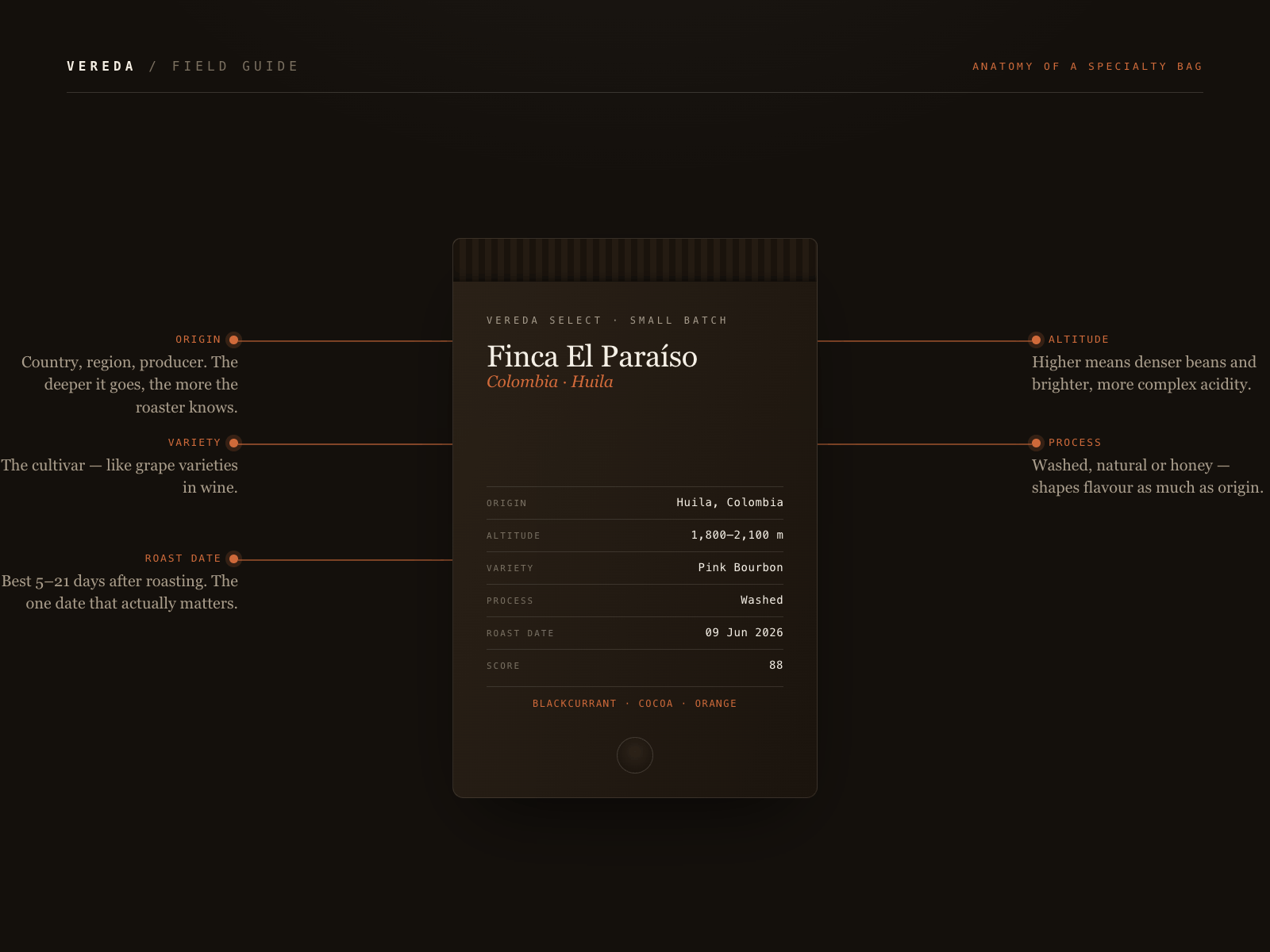
Every line is a clue. Read them together and the cup almost describes itself.
5. Process
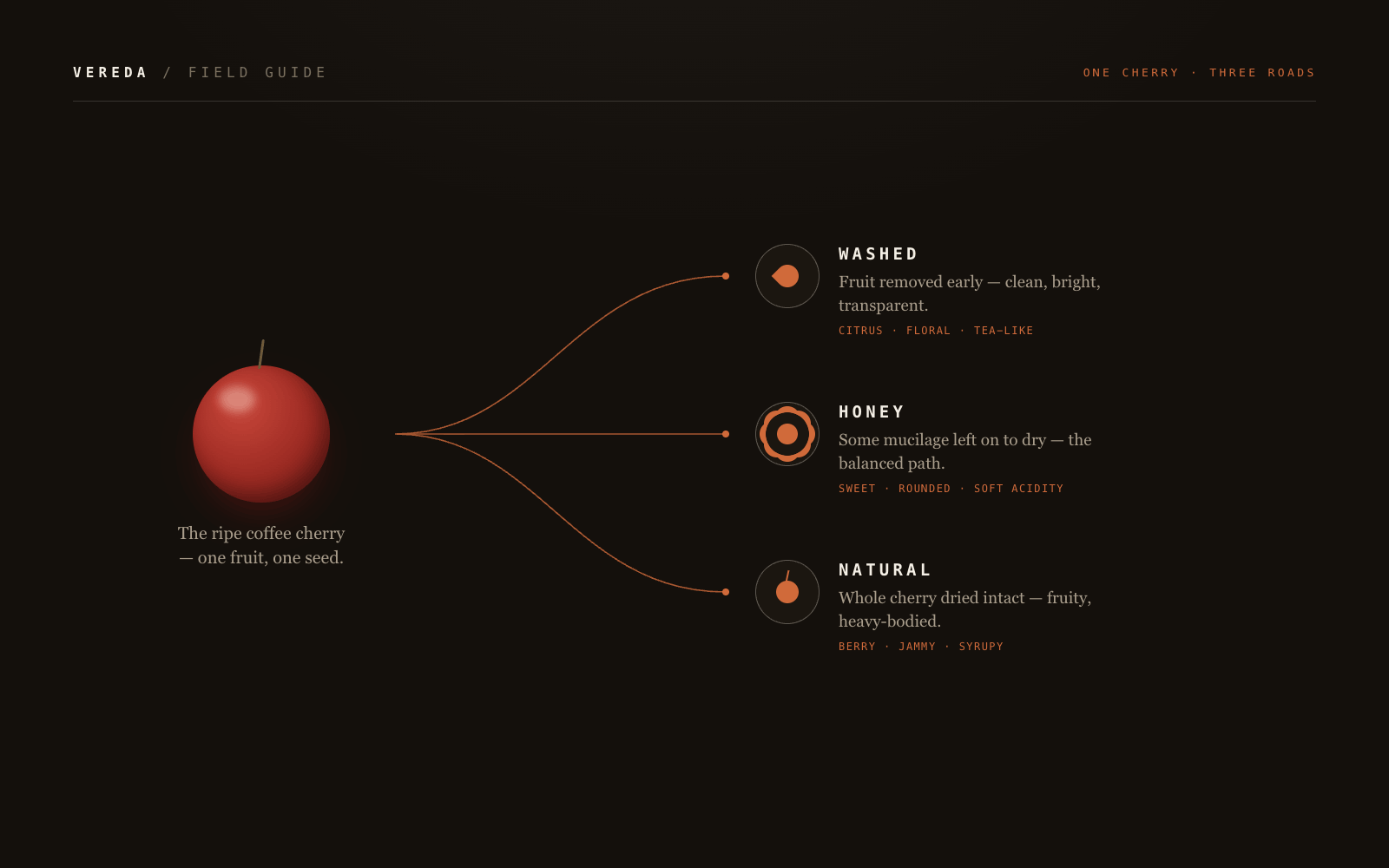
How the fruit was removed from the seed after picking — and it shapes flavour as much as origin does:
- Washed — clean, bright, transparent. The origin's true character.
- Natural — fruity, heavy-bodied, sometimes wild and jammy.
- Honey — somewhere in between: sweet and balanced.
(We go deep on this in Washed, Natural, Honey →.)
6. Roast date — the date that actually matters
This is the one most people miss. Specialty coffee is best not too fresh and not too old: it needs a few days to release CO₂ after roasting, and it fades after a few weeks. A good window is roughly 5 to 21 days past the roast date for filter, a touch longer for espresso. If a bag shows only a far-off "best before" and no roast date, treat it as a commodity product, not a specialty one.
The rest of the small print
- Tasting notes are predictions, not ingredients. "Blackcurrant, cocoa, orange" means a skilled taster found those flavours — nothing is added.
- Roast level — light to dark. Specialty trends light to preserve origin character.
- Score — an "86" or "88" is the cupping grade (80+ is specialty).
- Weight — 250 g is the standard specialty bag.
- Whole bean vs ground — buy whole bean and grind fresh; coffee goes stale within minutes of grinding.
Common questions
What does "natural process" mean on a coffee bag?
The coffee cherry was dried whole, with the seed still inside the fruit, before hulling. That extra fruit contact tends to make the cup fruitier and heavier-bodied than a washed coffee.
Is higher altitude always better?
Higher generally means denser beans and more complex acidity, but it's one factor among many — variety, processing and roasting matter just as much. It's a strong signal, not a guarantee.
Why is there a roast date instead of an expiry date?
Because coffee doesn't spoil so much as fade. The roast date tells you where the coffee is in its flavour life; a distant "best before" tells you nothing useful about freshness.
On Vereda, every roaster's bags list exactly these fields — origin, altitude, variety, process, score and notes — so you can read a coffee before you buy it. Browse roasters on Vereda →