Three drinks, not one
People use "iced coffee" for everything cold, but there are really three distinct drinks, and they taste nothing alike:
- Cold brew — coffee steeped in cold water for 12–24 hours. Smooth, low-acid, low-bitter.
- Classic iced coffee — hot-brewed coffee, cooled and poured over ice. Familiar, but easily watery.
- Japanese iced (flash brew) — brewed hot, straight onto ice. Bright, aromatic, ready in minutes.
Pick the right one for the coffee you have and the result you want, and your summer cup gets dramatically better. Here's how each works.
Cold brew
Coarsely ground coffee is steeped in cold or room-temperature water for 12 to 24 hours, then filtered. Because no heat is involved, very little acidity or bitterness is extracted — you get a smooth, mellow, chocolatey cup that's gentle on the stomach.
It's usually made as a concentrate (around 1:8 coffee-to-water) and diluted to taste with water, milk or ice; or brewed weaker (about 1:15) to drink straight. Made strong, it can pack more caffeine per glass — though that depends entirely on how much you dilute it. The trade-off: you lose the delicate floral and fruity notes that heat brings out, and it takes most of a day to make. Brew a batch on Sunday and it keeps in the fridge for several days.
Classic iced coffee
The simplest method: brew coffee hot, let it cool, pour it over ice. It's quick and it's what most cafés mean by "iced coffee."
The catch is dilution. Hot coffee poured over ice melts the ice and waters down, which mutes flavour and can leave it tasting flat. The fix the pros use is to brew it stronger than usual so the melt brings it back to balance — or to chill it fast rather than letting it sit.
Japanese iced (flash brew)
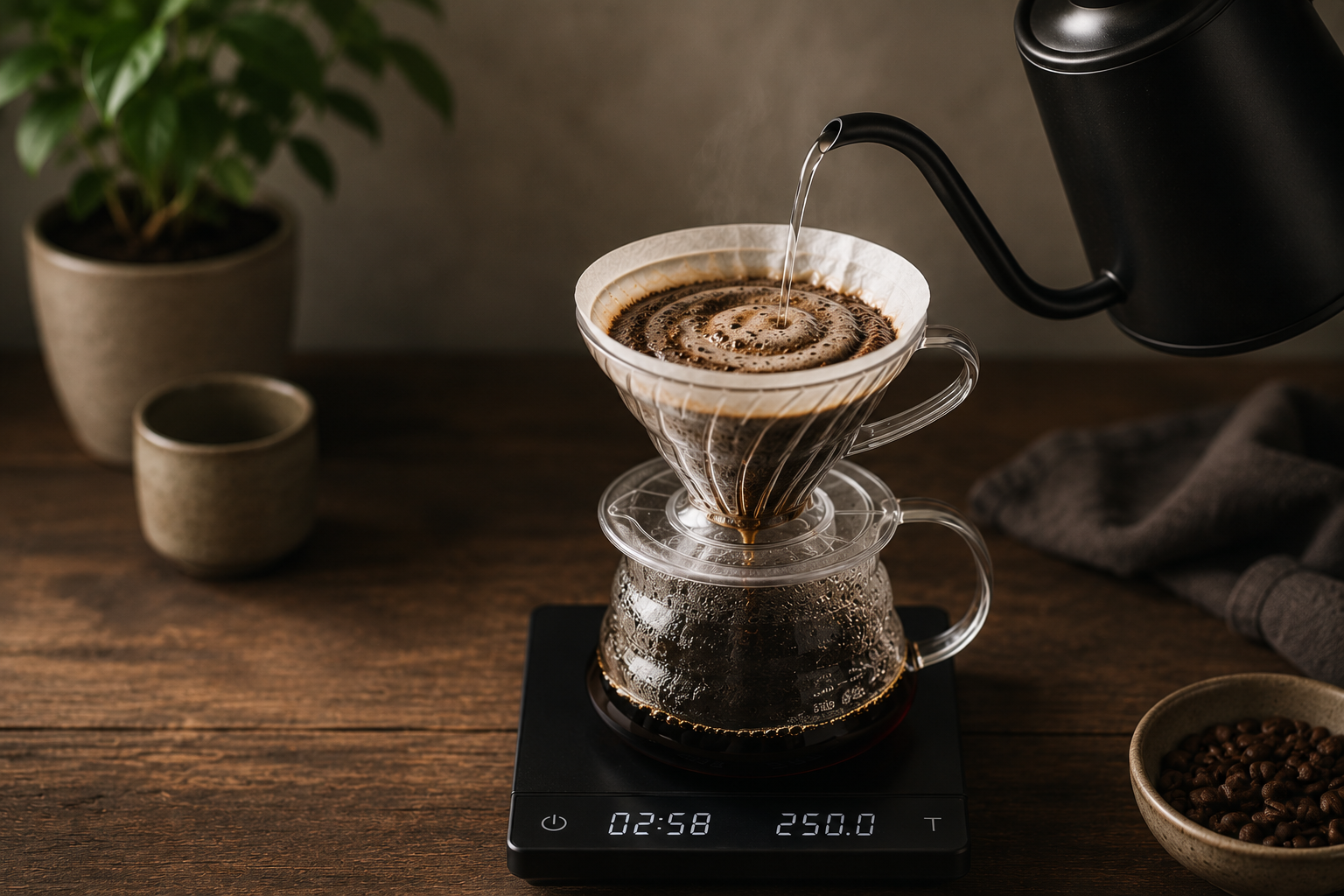
The connoisseur's choice, and the fastest of the three. You brew a normal hot pour-over, but you replace part of the brew water with ice in the carafe so the coffee chills the instant it drips.
Hot water extracts all the bright, floral, fruity aromatics; the ice locks them in before they can fade. The result is a cold coffee that's vivid and aromatic in a way cold brew can't match — perfect for showing off a light-roasted single origin.
A simple recipe: for a ~300 g drink, put 100 g of ice in the carafe and brew with 200 g of hot water over 20 g of coffee (a normal-ish ratio, just with a third of the water pre-loaded as ice). Brew as you would a V60, swirl, and serve over fresh ice.

Same beans, three methods, three completely different cups.
Cold brew smooths a coffee out. Flash brew sharpens it.
Which should you make?
- Want smooth, low-acid, batch-friendly? Cold brew.
- Want to show off a bright single origin? Japanese flash brew.
- Just need something cold from coffee you already made? Classic iced.
Common questions
Is cold brew stronger than iced coffee?
It can be — cold brew is often made as a concentrate, so undiluted it carries more caffeine. But once you add water, milk and ice, "stronger" depends entirely on the dilution. Brewed and served at the same strength, there's no magic boost.
Is cold brew less acidic?
Yes. Brewing without heat extracts far less of the acidic compounds, which is why cold brew tastes smooth and mellow and is often easier on sensitive stomachs.
What's the difference between cold brew and iced coffee?
Cold brew is brewed cold over many hours, so it's smooth and low-acid. Iced coffee is brewed hot and then cooled, so it keeps more brightness — and, if you're not careful, more dilution.
Many cafés on Vereda serve all three through summer — find one near you and taste the difference side by side. Explore on Vereda →